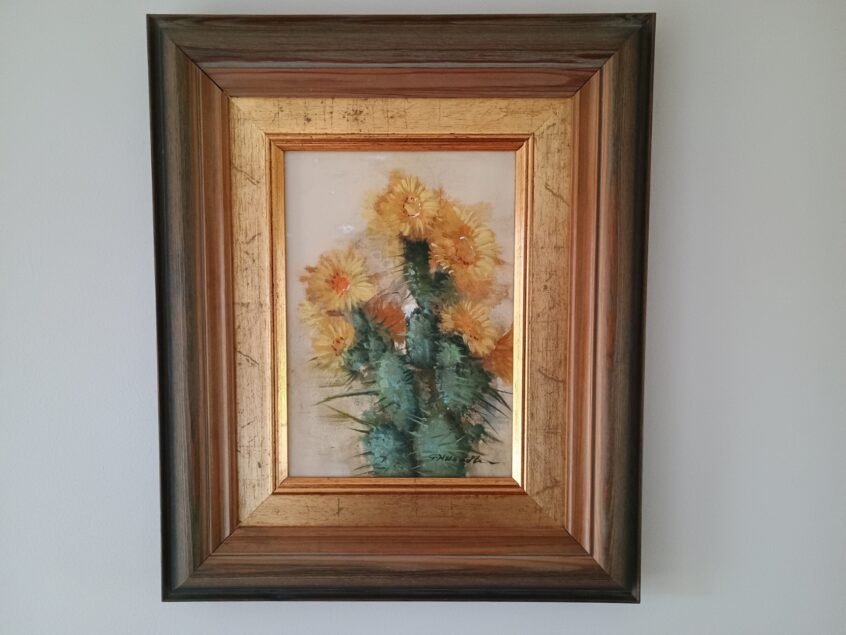
Do you have paintings on the walls of your home? For many years, we didn’t, mainly because we lacked the spare money to afford such things. But, more recently, we have been able to acquire quite a few from house clearance auctions. I am particular about where to display these, such that after last redecorating our dining room, the walls remained mainly bare for a couple of years as I resisted the temptation to just put some things up for the sake of doing so. However, this has recently been remedied, and the new décor includes a particular work that is in direct eyeline when approaching the entry to the room from our kitchen. This picture is a rather indistinct original painting, an image of a flowering cactus. I appreciate that this subject, with its spikey leaves, must be quite challenging for an artist to portray clearly, but nevertheless, it takes a certain level of concentration to recognise what this particular image is meant to be. What makes this work worthy of display isn’t the art itself but the frame that it is mounted in.
Framing
How things are framed makes all the difference, whether these are paintings that hang on the wall or ideas, policies or the gospel message. The image in question has a frame created using a wide, multi-faceted moulding. The inner component is a broad gold stripe that stands out, looks really good, and tones in with the yellow of the cactus flowers. It is the frame that is noticed before the actual image portrayed by the artist. This is all very well as a decorative item, but surely for a painting on the wall, it is the picture that is important rather than the frame – the work of the artist that we should be noticing and celebrating. The frame is helpful in providing a setting for the picture, but when it becomes the main feature, then isn’t there something wrong?
Form over substance
We can be like this in our lives as Christians, where we place form above substance. We may do all the ‘right’ things, such as attending various church meetings, socialising together, even reading our Bibles and praying, but accept that our actual relationship with God is vague and indistinct, like my cactus picture. Our lives can appear to be well framed, but it is the frame that has taken precedence; the reality behind it being unclear and insubstantial. For Christians, it is the reality of the artist’s work that is all important; how God has formed us, the degree to which his image is imprinted upon our hearts and lives (Romans 8:28; Colossians 3:10). Such an imprint comes through the work of the Spirit of God and is a reflection of a real, vital relationship. The frame may look good, but it is only the picture that has any meaning – that is valued by God. Our Christian activities are undoubtedly of some use, but only as they reflect and encourage that which is truly important.
Causes
Our spiritual lives can be indistinct for various reasons. Most notably, of course, if we have never actually made a transaction with God, been born again of his Spirit, such that we are transformed from death to life. Without this, we may be Christianised, but unless we have been born-again, we have no claim to actually being a Christian (John 3:3-6).
Or, perhaps we have received salvation, but have lost focus on spiritual reality; we might have been sucked into a religious treadmill of activity, but not realised the true significance of our actions. Maybe we started well, but became distracted by focusing upon a role that we have taken up, such that it is this that consumes all of our attention, rather than God himself.
Our spiritual lives may be indistinct because we are uncertain about what we believe. Our theology can be unclear – our system of belief. We aren’t all going to be theologians in a scholarly sense, but we do all have a personal theology, and this is something precious that needs to be nurtured (2 Thessalonians 1:3). If we adopt spiritual ideas without question, then our theological foundation will inevitably be flaky, indistinct and unreliable. We need to ensure that there is a firm foundation for everything we believe, that this is clearly scripturally based and that we embrace it fully. See Matthew 7:24-27
Prominence
I mentioned that our painting hangs in a noticeable place within the dining room. It is the function of such works of art that they should be displayed, viewed and appreciated, rather than hidden away in a corner, or in storage. Usually, artists go to a lot of trouble and use great skill to produce them. We honour this effort when the results are displayed well; we celebrate the artists themselves as we recognise and enjoy their achievements. In Matthew 5:14-16, we read:
“You are the light of the world. A city set on a hill cannot be hidden. Nor do people light a lamp and put it under a basket, but on a stand, and it gives light to all in the house. In the same way, let your light shine before others, so that they may see your good works and give glory to your Father who is in heaven.”
Similar to images that are painted to enrich our lives, we have been created to honour God who made us and brought us into salvation. We are his workmanship and need to ensure that we display the light that we have been given, proclaiming the goodness of God, demonstrating the grace he has shown towards us, and pointing others to him.