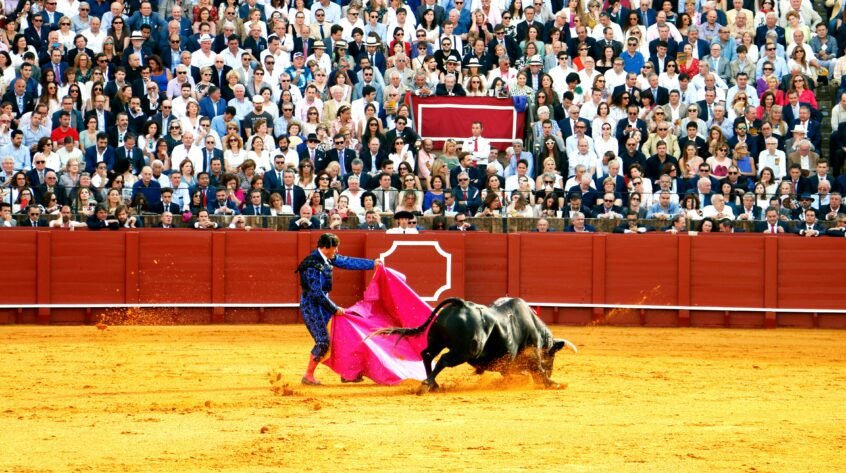
Our eight-year-old granddaughter came into my study the other day and, after considering a painting that hangs here, asked what it was about. We acquired this particular picture as part of an auction lot some time ago; it isn’t one that Jean or I like. You might wonder then why we have given it house room. The quality of the painting is very poor, and the frame is nothing special. The image is impressionistic, indistinct, and of what many people would consider an offensive subject. All together, this piece of art has little to commend it. Neither of us would be happy for it to be displayed anywhere else in our home, but it fits in my study for two reasons. Firstly, the paint colours tone in well with the colour of the walls, and secondly, the image is evocative of a spiritual reality.
Conflict
This picture is a close-up view of a matador in a Spanish bullring, inflicting injury to a raging black bull. It reminds me of something that it is easy for us to forget, namely that as Christians, we are inevitably engaged in a conflict with the forces of darkness. This isn’t something that we should be fearful of, but it is a reality just as much as what happens in a bullfight. I have often sat and considered this picture to try to figure out which of the two combatants is analogous to us as Christians and which to the evil one. The bull certainly looks dark and menacing, but it is the matador who is inflicting damage upon the bull. I can see something of the Evil One in both, and something of Christian behaviour in both as well. Perhaps it doesn’t matter, and we can accept that this rough and ready piece of artwork is simply a reminder of the battle in which we are engaged.
Emotions
The actions of the bull can hardly be viewed as measured and considered. Although we see only a snapshot, we understand that this animal has been stomping around, driven by instinct rather than thoughtful consideration. He is dangerous because of his bulk rather than his tactics, although he is certainly intent on causing harm. His opponent, on the other hand, is calculating in his actions; he wants to avoid being injured and to rejoice in and be applauded for his victory if the bull is finally vanquished. We see the beast as dark and dangerous, which may correspond with how we view Satan, but equally how we as human beings are sometimes driven if we allow our emotions to have free rein. Emotions are powerful things and, while they are an important element of who we are, we get into difficulty if they are not checked but allowed to drive our reactions and behaviour. Proverbs 25:28 reads: “Like a city whose walls are broken through is a person who lacks self-control.” See also Ephesians 4:31.
Either way
The matador is standing up to the bull, resisting its violent rampaging and seeking to conquer it and thwart its attack. This is our place as Christians who aim to assert the name and power of Jesus over the activities of the forces of darkness. But, similarly to Satan, the matador is calculating, artful, and has his emotions in check – there is a real sense in which he is playing a game with the bull, one that he has every intention of winning. Either of the combatants can be seen as the aggressor, and either as the prey.
Burning
This brings to mind the passage in Ephesians 6 where Paul uses the analogy of physical armour. One of the components that is mentioned is the Shield of Faith: “In addition to all this, take up the shield of faith, with which you can extinguish all the flaming arrows of the evil one.” (v16). This item reminds us of the nature of our conflict with evil because of the mention of ‘flaming arrows’. Just as in my picture, where the matador is harpooning the bull, these arrows are designed to cause injury. But, more than this, they were dipped in pitch and ignited so as to burn the flesh, which is akin to how Satan’s attacks can cause us deep pain. Interestingly, the shield mentioned in this verse refers to the Roman ‘Scutum’, a large rectangular device designed to protect the whole body. It is made of wood, but also coated with another material. I have always understood that to be cork, but my latest investigation suggests leather that was moistened. Either way, this armour was designed to protect the whole body; to deflect missiles, but also to extinguish any flaming arrows that became embedded in its surface.
Declaration
Like it or not, as Christians, we are engaged in a battle. If we are to be faithful to God, then this isn’t optional. Yes, we could keep our heads down in an attempt to avoid trouble. But this is not the way to honour our Lord and Saviour – it is not kingdom behaviour. I also dare to say that avoiding such conflict is cowardly. I don’t, of course, suggest that we should seek out a fight, but rather that we must not allow ourselves to be cowed when challenged, whether directly or by the expectations of others. Also, we should not avoid declaring biblical teaching and principles with confidence. By definition, there can be nothing wrong with what is clearly taught in the Bible – that which the Christian church has long stood for. The only ‘wrong’ associated with this is if we avoid teaching such truth. We don’t proclaim kingdom principles to be provocative, but to help others to understand how to live faithfully for God.
We are all familiar with the declaration in John’s gospel account (John 3:16), where he writes: “For God so loved the world, that he gave his only Son, that whoever believes in him should not perish but have eternal life.” God also loved us enough to equip us with teaching about how to live holy lives in the here and now. See 2 Timothy 3:16.
Victory
As we are thinking of spiritual battles, we are reminded that Jesus has already won the battle with Satan; what we are engaged in might be seen as a mopping-up exercise. But in undertaking this, we have all the authority we need – we are his footsoldiers in this battle, his agents, acting under his authority and in his name. There will, of course, be a fight, but we are on the winning side. See 1 John 4:1-6