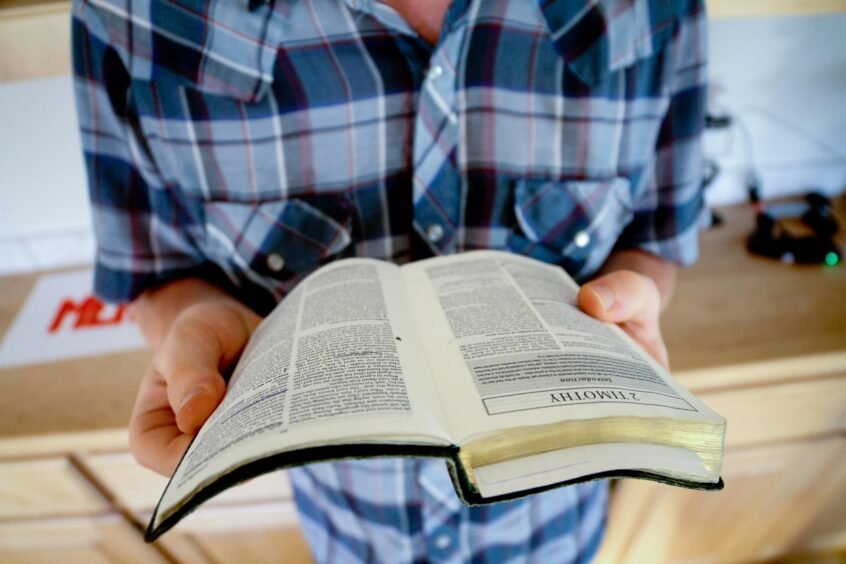
Differences
I have become ever more conscious, as the years have passed, that we aren’t all the same. This may seem an obvious thing to note, but an important one because it means that we can’t expect others to be the same as us. The more aware we are of this, the better. That doesn’t mean that we should not seek to emulate the godly behaviour that we see in other people, but at the same time, we must avoid being constrained to following particular patterns. These differences apply to our reading of scripture. You, perhaps, have types of Biblical writing that you find to be more meaningful than others. For instance, many Christians love reading the Psalms, while others may be more at home with the New Testament (NT) letters or maybe the history books of the Old Testament (OT).
A friend once confided in me that he only read the four gospel accounts, cycling through them repeatedly. I pointed out that in doing this, he was missing out big time. Clearly, the gospels are essential reading, but they are only one part of the biblical story.
Floating on air?
I want to draw your attention to the Old Testament and highlight why this is important for us as Christians, but also to warn about confusing what we read there with New Testament teaching. As a young Christian, my focus was very much more on the NT, such that when I went off to study at Bible College, my familiarity with the OT was very limited. I still tell people who are new to faith that they should concentrate on reading parts of the NT before delving into the OT books, simply because the NT is where we read about Christian faith. But this in no way invalidates the OT. The NT is where Christians reside, but the OT also holds much truth, giving us the basis that provides the context for the new.
The foundations of a building dictate what can be constructed above ground, and the ground floor structure provides the basis for what is built on the next level. I suggest that the Old Testament is akin to the ground floor, built upon the truth of who God is. Then the NT sits as the next floor, constructed on the basis of the ground floor – without that lower level, the NT writings would be floating in mid air!
Covenants
The words ‘New Testament’ relate to the new covenant that God brought into being through the death and resurrection of Jesus. This supersedes the various covenants that we can read about in the OT, and that is where we need to be careful. Through this new covenant, we are a new creation in Christ. The old has passed away …. the new has come (2 Corinthians 5:17). We have no business harking back to the superseded covenants of the OT, other than to help us in our appreciation of the new covenant. The Old Testament rules and rituals may appeal to our religious instincts, but they have no place in our spiritual lives as Christians: there is no temple (other than within our hearts), no sacrificial system (Jesus provided the single, enduring sacrifice for sin), and consequently, no altar for sacrificing and no special priesthood for making such offerings (all believers have a priestly role – 1 Peter 2:1-5). The NT writers make this distinction very clearly, recognising the tendency, within those with a Jewish heritage, to be led astray by false teaching that attempted to curtail their freedom in Christ (Galatians 5:1).
Overview
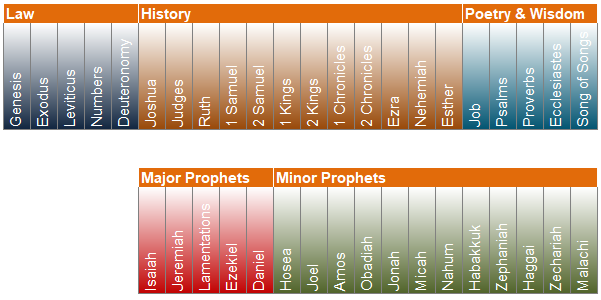
The Old Testament writings take up more than 75% of the pages in our Bibles. Whilst we might struggle to navigate the broad array of writings contained there, the very volume should suggest to us that we ought not to ignore this, or limit where we read therein. This part of the Bible contains books that are grouped as follows:
Books of the Law: These are the first five books: Genesis through Deuteronomy. Although they are classified as books of the law, they contain a lot of narrative, including the early history of the Jewish nation, especially within Genesis and Exodus. These two books are a useful place to read in the OT, and not just because they are the first two.
Books of Jewish History: These are what it says on the tin! They cover various periods in the history of the Jewish people, culminating in the exile in Babylon and their subsequent return some 70 years later. My personal favourite of these is the book of Ruth, which is quite short and has a great storyline. This is important to read because Ruth was to become the grandmother of one of the key figures in Jewish history, King David.
Poetic and wisdom literature: The books of Job through Song of Songs are classified as the poetic and wisdom literature. I often suggest Proverbs as a good place to read here; this contains a great deal of wisdom that is as relevant to us today as when it was originally written.
The prophetic books: These are separated between Major and Minor prophets, based mainly on how long they are. Isaiah is a valuable read amongst these, especially as it contains many clear and well-known references to the coming Messiah, Jesus. That said, Isaiah is not the easiest to appreciate for someone unfamiliar with the OT; it might be better to start out with the book of Jonah, which has a straightforward narrative and message.
The chart below shows the breakdown of the books of the Old Testament, according to their classifications and in the order in which they appear in the Bible.
The Old Testament Books
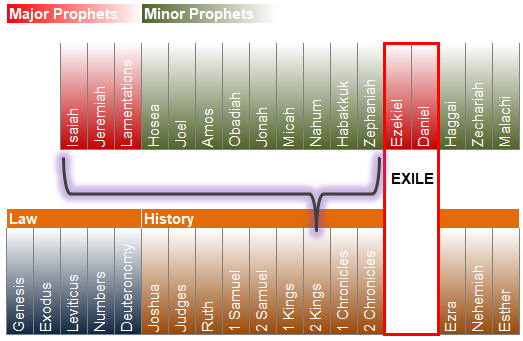
The next chart shows how the prophetic books relate to the history of the Jews in the OT, including which of these were penned during the time of the Jewish exile in Babylonia. Although the prophetic books are listed last among the OT writings in our Bibles, they mostly relate to the historic period covered by the second book of Kings.
Chronological Sequence
It is interesting to note that the last of the prophetic books of the OT, Malachi, was written some 400 years before the birth of Jesus, which is indicative of the spiritual malaise during this intertestamental period. When reading the gospel accounts, some people skip over the genealogical lists in Matthew 1:1-17 and Luke 3:23-38 because they find the names there to be unfamiliar. Those same names take on new significance as we discover who they were from reading the OT writings.
Encouragement
If you are not very familiar with the Old Testament, then I hope that I have encouraged you to delve in there a little more. Maybe have a go at reading one of my suggested books and see how you get on – if you are still reticent to do so, then at least give the book of Ruth a try (it has just 4 chapters).
I am a great believer in having a balanced diet, both nutritionally and spiritually. Some people like to read each day from both the NT and the OT, which is one way of achieving balance. Personally, I prefer to take a book at a time – a chapter per day – but I take care to balance out the books that I choose to read, prayerfully considering where to select next.
I recognise this post is out of the usual pattern of this BLOG, but I hope that you have found it helpful.