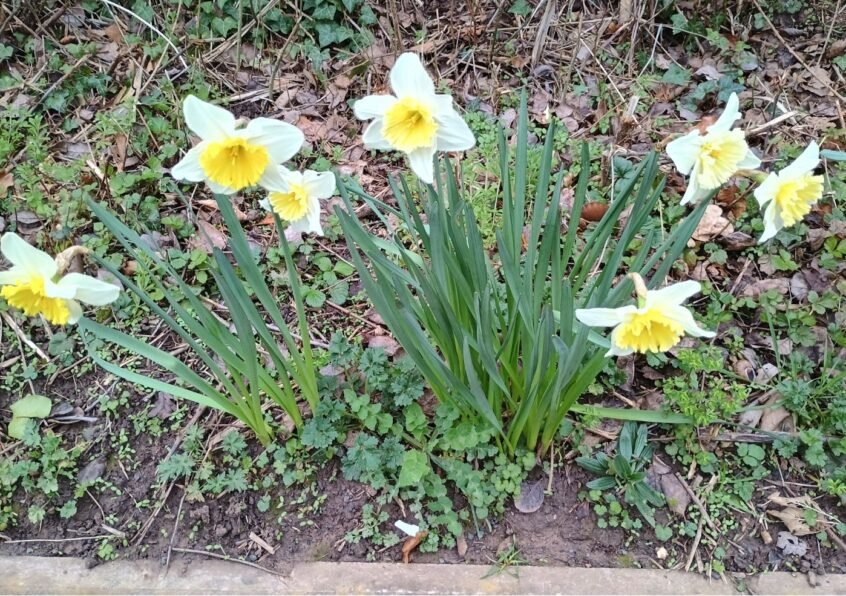
When out for my early morning walk today, I came across something that delighted my heart. The day started rather cool, but bright. Despite the low temperature, there were some white daffodils in bloom beside the path. I love flowering bulbs, not because they provide the first signs of new life after the drabness of winter, but because of their form, texture and colours. I am not sure whether my enjoyment originates from growing such bulbs in pots in my youth, or whether their appeal was my motivation for doing so; either way, they bring me joy.
The picture
The first artwork that we purchased from an auction after moving to Worcester was a miscellaneous bundle of items that the auctioneer had obviously decided were unworthy of selling individually. As a consequence of their implied low valuation, my modest bid was successful. Amongst these pieces was an original, skillfully executed, painting of a vase of spring flowers. Despite our owning some other artwork that has significant sentimental value, this particular picture is the one that I would most want to keep. I value original work; I delight in the display of skill and quality of composition, and as explained, I rejoice in this particular subject matter.
Undervalued
One reason why this painting was undervalued is that the artist’s signature is barely detectable. However, upon close inspection, I have been able to discern it. It turns out that she is someone known for this type of work. When I discovered this, my thought was that I would love to have a set of such images, depicting the flora of all four seasons. This may be achievable, but not at the bargain prices that I like to pay! Consequently, I must be content with just this one picture.
Revelation
We can all appreciate the beauty and artistry in the creation, whether on the grandest scale seen in the heavenly bodies, the magnificence of a mountain range, the intricacy of nature that surrounds us or the pinnacle of all creation, a human being. Many people recognise that these things haven’t come into being by chance; that there must be some intelligence behind the design; a real, creative force, to bring everything into being from nothing. And yet they stop at this point because the artist’s signature is not bold and brash; to be found, it requires a heart set on discerning its presence – a willingness to seek, and an openness to recognise. In Acts 17:16ff, we read of Paul’s encounter with the Greek philosophers of his day. He had been observing their objects of worship and found an altar inscribed for ‘An Unknown God’. It was this object that provided a platform for him to reveal to them who that unknown God is. The presence of such an altar indicated that those people recognised that they were missing something, but also that they had no idea what that was – they were unable to make out the signature (see Romans 1:20). The eyes of some of Paul’s listeners were opened; others were unsure but willing to hear more of his teaching.
Entrusted
Today, there are those who are open to hear the gospel that Paul preached in Athens, the message about the purpose of God, his love and offer to meet any of us just where we are, in need, brokenness or confusion. This is the message with which we, his Church, have been entrusted. Just as Paul met the Athenian philosophers right where they were, we must follow a similar pattern, maybe stepping out of our comfort zone to engage with those around us in ways that are meaningful to them, whilst remaining authentic to who we are.
Authentic
Authenticity is supremely important. Even as Christians, we can be enticed into embracing gimmicks or attempting to appear trendy as a means of ‘reaching’ others. We might find ourselves going out of our way to be acceptable, affirming worldly perspectives instead of declaring kingdom ones. If we are to stand firm against the secular tide, then we will only be able to do so if we are firm in ourselves and realistic. We must be authentic in both our faith and practice.
Perhaps you are wondering what this has to do with the idea of seeing God’s signature. If we are to be authentic within ourselves, then we need to recognise his hand in our own circumstances. Some people adopt a simplistic position whereby anything that they consider to be bad must not be a part of God’s plan. They take the opposite position on anything that they think of as good. Of course, we should all be grateful when we sense his hand of blessing, but maybe we need to look closer at the other things to see if, perhaps, his signature is there too. I can look back on tough times and difficult circumstances, through which, with the benefit of hindsight, I now see that he was preparing me for the future. God does not always work in the ways that we like to expect; sometimes we must look carefully for his signature to see whether the circumstances we find ourselves in are from his hand, before deciding on our own that the authorship belongs somewhere quite different. This is highlighted for us eloquently in the story of Joseph, where God had his hand on that which was meant for evil, and might appear to be a harmful circumstance, but was actually his plan for good – Genesis 50:20.
Reaching the mark
Our witness depends on our authenticity; the way we handle our own lives and circumstances, as well as how we relate to others. We need to have open hearts towards God, and listening ears to hear what he is saying so that we don’t step out of line. A lack of such discernment will undermine our authenticity, and anything that is not truly authentic will not reach the mark. On the other hand, where we display authenticity, the message of his grace will win through despite our human failings and limitations. Authenticity is a mark of his hand being upon us – both on our lives and our Christian witness.